Fear, pray, live forever—fürchten, beten, ewig leben—these are the section titles of an essay by Raphaela Edelbauer in our Reader 7, in which the Viennese novelist examines the religious-pharmacological complex of longevity. Backed by hefty investments from tech billionaires with a penchant for eugenics, a strange cohort of self-optimizers, supplement gurus, and chastened or converted Christian nationalists in the United States advances a way of life that is as neoliberal as it is devout: live the disciplined, optimized, and fearful life of a contemporary longevity monk and your life shall last forever. At 48 years of age by the Gregorian calendar, the tech rentier Bryan Johnson has become a kind of spiritual leader of the movement, boasting an aging coefficient of 0.6 or, for certain body parts, less than zero. The Netflix documentary devoted to his longevity regimen (which is barely distinguishable from a marketing clip) informs us that Johnson is the lucky owner of the anus of an eighteen-year-old.
Viewed from the Old World, this solutionist approach to cellular decline appears quintessentially American, or, to be more precise, Californian. It is the expression at once of extreme strains of individualism, materialism, and literalism: only if one’s body and brain physically persist can they attain eternity (while the upload of brain structures into an AI is discussed as a brain-centric, post-corporeal alternative). Seers and sages across the ages, however, have always known eternity to be attainable within this life: for centuries it was the remit of poets and hermits, homeopaths, witches, and midwives, and even of ordinary patriarchs and tribal leaders, to teach techniques of self-perpetuation that were based not on the idea of individual preservation but of transience. It is the transmission of our wisdom, work, and life achievements that may allow us to perdure. Strive for perfection once; then make sure that those who come after you, be they your spiritual or biological “children,” “students,” or “disciples,” have the best means at their disposal to continue your unfinished labors towards perfection. This was, and still is, the only way for humans to see their achievements live on.
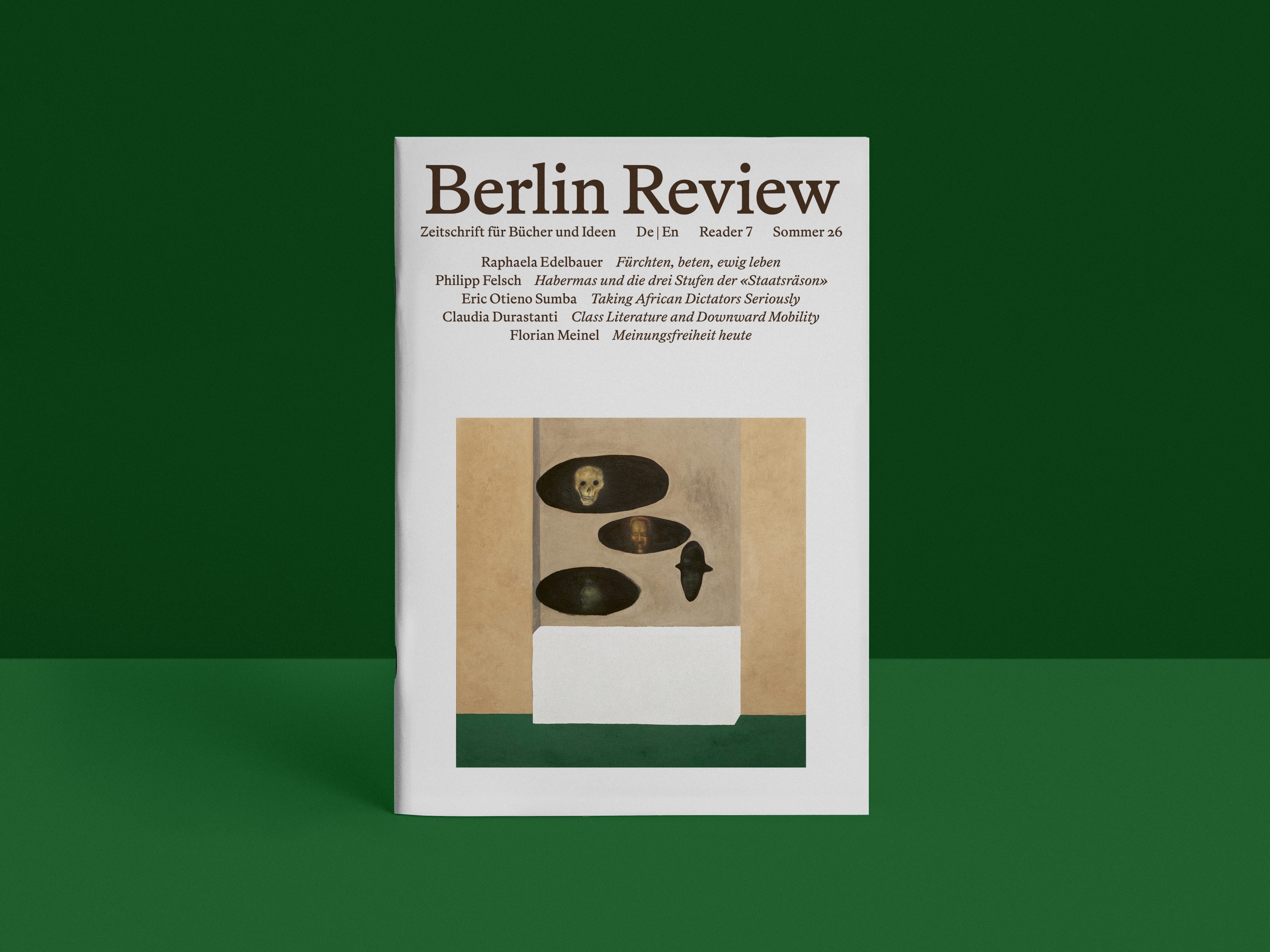
If this traditional means of transcending mortality ever had a corporeal dimension, it was hardly youthful. On the contrary, it depended on the wisdom of old age. The highest goal was a kind of spiritual perfection that would render biological youth irrelevant. The German language has a slightly melancholy word for this agelessness of spirit, usually applied to children or adolescents: altklug (“old-smart”). To be altklug is to have mentally outgrown one’s own young body; an altklug child knows too much to be truly young, yet has somehow preserved the guilelessness of youth. The oppressive yet strangely compelling feeling of never really having been young—of having seen and endured too much, yet experienced too little—may itself be a form of longevity, one that resembles the condition of many young people today.
Detachment and agelessness, a difficult-to-decipher pessimism tempered by humor: these are the sensibilities that fill our Reader 7. Pol Taburet, a Parisian painter still young by any standard and our artist of the issue, gives them visual form. His shift from garish to more muted tones, and the ways his palette draws on Afro-diasporic and Caribbean traditions, are explored in an accompanying essay by my colleague Meret Weber.
The “problem” of death and dying—of what happens when those living alone inevitably die—is addressed by a team of Max Planck researchers in their essay “Dying Alone.” (One of its authors, Biao Xiang, has spoken with us about the piece in a recent episode of our podcast Airlift.) In his review of a recent book by Mahmood Mamdani, Eric Otieno Sumba considers what distinguishes two African dictators not only from one another, but also from the many misleading frames of comparison through which Western observers have viewed post-independence African politics in general. Marius Goldhorn casts an I Ching for us—that is, “three coins, six times”—to evaluate internet wisdom on the subject of Chinamaxxing, while Maha El Hissy concludes her four-part series on Palestinian literature, whose invisibility is particularly acute in Germany for reasons discussed at length in our pages over the past two and a half years.
Sinthujan Varatharajah examines a counter-canon of antifascist architecture that increasingly languishes beneath the monumental shadow of Neoclassicism and Rationalism. Miriam Stoney asks why racialized characters are so rarely permitted to be unlikable, and Claudia Durastanti bids farewell to the “transclass writer”, a central figure in recent European literature to whose ascent she herself contributed. Edna Bonhomme reviews Cristina Rivera Garza’s Autobiography of Cotton; Enis Maci consults the AI oracle of ugliness; Karosh Taha writes of aerial bombardment, torture, and investigation in Iraq; and Faith Hillis considers the tradition and revival of Jewish radicalism through two much-discussed books. Florian Meinel and Philipp Felsch expose the weak points of two monuments of the Federal Republic—the Basic Law and Jürgen Habermas—while Diedrich Diederichsen, finally, reports on the “rogue-state pavilions” of this year’s Venice Biennale, where, as he recounts, it smells suspiciously pleasant.
We wish you a stimulating summer of reading.
— Berlin, June 2026